
The only way that you, the listener, will become familiar with the genres and able to make your own judgments is by exposure. That is how I began, that is how everyone begins and, in many ways, ends. After all, this is music, and personal preference is going to determine what you listen to and what you don't.
So why not start out with what I believe is absolutely exceptional? You will find plenty of mediocre, typical music in your search. The whole point of a critic is to start you on the right path. So in this post I will be reviewing Ulcerate's Everything Is Fire, Blut Aus Nord's Memoria Vetusta II, and Ahab's The Divinity of Oceans. All three are solid tens and were on many Top Albums of 2009 lists, including my own.
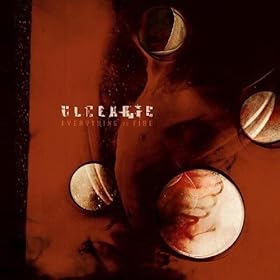 Ulcerate - Everything Is Fire
Art: 5/5
I first heard this album described as "technical death metal," and made certain assumptions about it. The drums would go a million miles an hour, the guitars would go "widdly widdly djent djent djent" and it would sound like dozens of other tech death albums. In a word, it would be boring. I was utterly wrong. These New Zealanders have produced something completely unique in all of death metal. It isn't necessarily all fast, but the intensity level is unrelenting. Ulcerate, in fine metal tradition, sing about the human condition and about the end of all things.
Ulcerate's musicianship astounded me, especially when I watched raw drum tracking videos on YouTube of Jamie Saint Merat recording the album. You can feel the fury of the band through the music, a tornado of realization picking you up and slamming you mercilessly into the cliff face that is humanity. The guitars layer in chords and rhythms that simply have not been heard in death metal before. The production keeps things wonderfully uncompressed, allowing the layers of guitars to breathe and fill every last space in your head. As I already mentioned, the drums are fantastic, with a rich, meaty bass drum and solidly refreshing snare drum snap.
Grip: 5/5
The first time I listened to Everything Is Fire, I didn't get it. It simply didn't conform to my idea of what technical death metal should be. Once I opened my mind to be responsive to this beast of an album, however, it never let go. Watching the drum tracking certainly got me excited to pick out the various drum parts, and this led to trying to decipher Michael Hoggard's many guitar layers. Everything Is Fire is my number one album of any style for 2009, and the title track, which closes the album, is my favorite of the eight monstrous tracks. Paul Kelland, the bass player, bellows the lyrics, and although they are indistinguishable without a lyric-sheet, that has never stopped me from bellowing right along. This album is all about energy flowing straight from the center of your being and being expressed in whatever way possible - the limbs of a drummer, the hands of a guitarist, the lungs of a vocalist. Everything Is Fire is unlike any other death album I have ever heard. Let it crush you.
Blut Aus Nord - Memoria Vetusta II
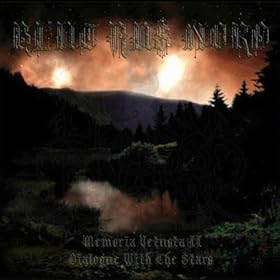
Art: 5/5
While Fire may be the element that defines Ulcerate's tour de force, Ice would be a better fit for French black metal band Blut Aus Nord's (pronounced bloot ah's nord) follow up to 1996's Memoria Vetusta: Fathers of the Icy Age. 2009's album, subtitled Dialogue With the Stars, has won acclaim from metalheads worldwide, being the number one album on MetalReview.com's official 2009 critics' list. Memoria Vetusta II is not a typical black metal album, featuring delay-laden acoustic guitars and Vangelis-esque synths, yet the tremolo riffs, furious blastbeats, and howled lyrics of black metal are certainly present in abundance. Dialogue With the Stars has such a reverb-laden production that the listener feels as though he is floating miles above the frozen mountains and forests of Scandinavia (yes, this is a French band with a German name, but black metal comes straight from the frozen north). Readers moving straight to this album from Everything Is Fire will notice that the snare drum is much more prominent in black metal than in death metal, and although the kick is still important, it isn't as thick or meaty as in death metal. This is typical of black metal, which often uses a much more raw or, as in this case, reverb drenched production than the intentionally fat, bass-heavy sound of death metal.
Grip: 5/5
I cannot forget the melodies of this album. Yes, it is extreme music, and yes, the vocalist howls and shrieks unintelligible phrases of philosophy from the mountain tops, but it is fantastically melodic. "The Meditant (Dialogue With the Stars)" and "The Formless Sphere (Beyond the Reason)," my favorite tracks, are about ten minutes a piece, but never feel as though they are dragging or outstaying their welcome. This is an album that I have played and do play multiple times in a row. The chords, built from layered tremolo guitars, wash over the listener with the unadulterated beauty of winter. Blastbeats create an arctic wind to bring the howled messages of Vindsval to us from whatever distant mountain he uttered them on. Sometimes reverb heavy productions like this one can wash out an album's sound, making it all feel weak or sluggish, but Memoria Vetusta II stays sharp and energetic, allowing the reverb to give the album that spacious feeling of flying, rather than the squish of mud.
Ahab - The Divinity of Oceans
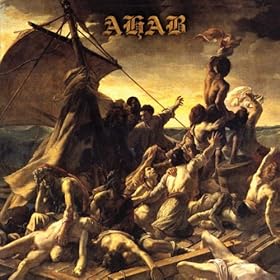
Art: 5/5
Doom metal proves that you don't have to play faster to be more extreme. German doomsters Ahab play a type of metal called "funeral doom," which essentially means the slowest, lowest music possible. Unlike some purveyors of funeral doom, however, Ahab includes harmony and melody prominently in The Divinity of Oceans. Many metal bands produce concept albums - albums built around one theme or story - but Ahab is a concept band. All their music revolves around the theme of whaling and Herman Melville's famous novel Moby Dick. I don't know a lot about whaling, but in my mind, this is what whaling should sound like. The slow pace and absolutely colossal tones transport the listener to a whaling ship tossed by the merciless ocean. I loved 2006's The Call of the Wretched Deep, which took its themes directly from Moby Dick, and so I was familiar with the band's sound when I first spun The Divinity of Oceans. Compared with their first album, this one is more melodic, containing more harmonic chords and less dissonance. Also, there is more melodic, layered singing, although the unearthly growls that sound as though The White Whale himself uttered them are certainly still prominent. This sonic change fits well with the thematic change from the Pequod to the Essex, the real-life ship that inspired Melville. Whale attacks, sinking ships, and cannibalism are all themes that Ahab growls about on The Divinity of Oceans.
Grip: 5/5
Again, the melodies play an important part here, enriching and emphasizing the massive feeling of the ocean about to crash down upon helpless humans. The lyrics (as we will find in most extreme metal) are barely intelligible without a lyric sheet, but that should not be any deterrent to the enjoyment of this album. The first entrance of the distorted guitars in "Yet Another Raft of the Medusa" should not be missed. It is the sound of the golden sun igniting towering breakers with solar fire and the sound of what those waves do to a human being alone on the ocean. If whalers had had electricity when they went out on their ships to fight the monsters of the deep, Ahab's albums would have been their soundtrack. Let The Divinity of Oceans suck you down. You won't mind if it drowns you.
I have posted these YouTube links to give you an idea of what the music sounds like. YouTube links are a sorry excuse for what music ought to sound like, especially bass-dependent music like metal. I'm currently trying to set up links for you to download these albums in mp3 from Amazon.com straight through my blog. That feature will be coming soon.
